
A small object, a long history
Let me begin with a small object. In a follow-up contact in October 2025, one participant told me that she had just had an intrauterine device (IUD) removed after sixteen years. The photograph she shared is almost too ordinary: clinical, small, easy to overlook. Yet it carries a long history. It belongs to an era when the state asked women to prevent births. It now appears in an era when the state asks women to consider more birth.

Figure 1. A participant’s IUD. Photograph supplied by the participant; permission to publish has been obtained.
That contrast matters. A state can change its policy faster than women can forget how policy entered their bodies, careers and marriages. The photograph does not stand for all women’s experiences; it offers a reminder that reproductive governance has a memory. If a woman has spent years being governed as someone who “should not” give birth, why assume women can immediately be persuaded to give birth in the national interest?
Counting births, counting trust
Birth rates can be counted but the memory of reproductive policy is much harder to measure. Within a single generation the state has swung from suppressing births to soliciting them: from the one-child policy of 1979, through a brief two-child interlude in 2013–2015, to the three-child policy of 2021 (Figure 2). China’s official statistical communique reported that in 2025 the country recorded 7.92 million births against 11.31 million deaths, and the national population fell by 3.39 million. The demographic story seems straightforward: China wants more babies, and it wants them soon. The numbers, however, do not explain why so many women remain cautious. The question is not really whether the state now permits larger families. It is whether work, care and public life have changed enough for women to trust that “invitation”.
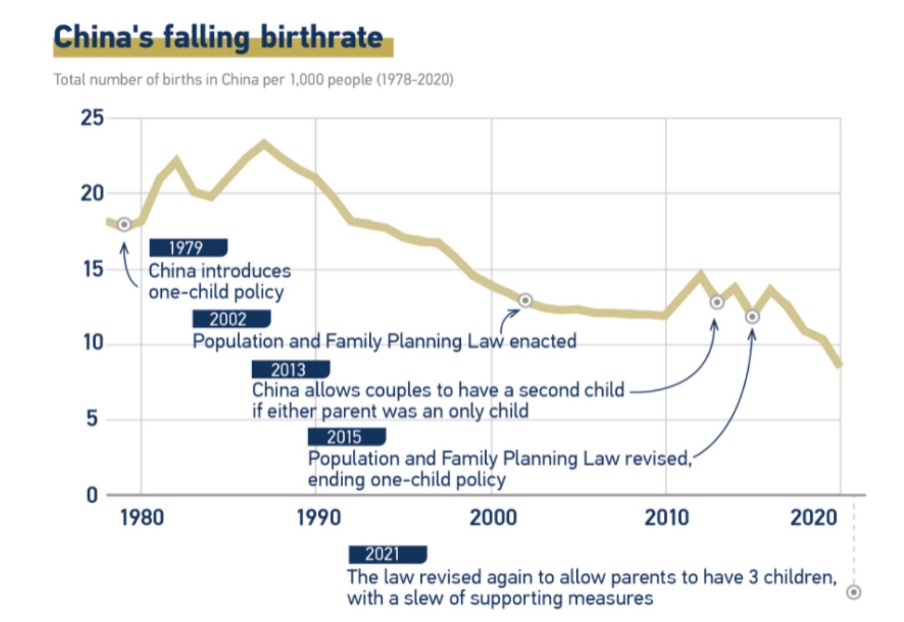
Figure 2. China’s birth rate, 1978–2020 (births per 1,000 people), annotated with the main turning points in family-planning policy. (Source: National Bureau of Statistics of China, 2021)
When China introduced the three-child policy in 2021, the reform could be read as a move away from restriction. Couples were now allowed to have up to three children, and on paper that looked like freedom. However, many women may hear a more complicated message.
My study draws on 44 semi-structured interviews with working women in China, mainly in the Information and Communication Technology (ICT) sector. It began with a plain question: how does a national demographic policy enter women’s working lives? The answer was rarely dramatic. It entered through job interviews, promotion worries, leave calculations, family conversations, online debate, and the private arithmetic of time, money and energy.
The freedom-pressure paradox
One of the most revealing findings was a paradox — the reproductive freedom-pressure paradox: a policy can widen formal freedom by allowing more births, but once that freedom travels through families, workplaces and public narratives, it can return as expectation. Women have more freedom to have another child, yet are also more exposed to the assumption that they might, should, or eventually will.
Several interviewees described this pressure with striking clarity. Lina (the names that follow are pseudonyms), a HR manager and mother of one, reflected on how earlier restrictions had shaped the timing of her life: “The one-child policy killed my chance to have a second child until I waited until the second-child policy was introduced; then I had the chance to have another one, but by then I was already almost 35 years old.” Mei, a mother of two, put the problem more sharply: “In front of the national interest, we women are always helpless and affected by various government policies… we are like a population tool.”
Recent studies point in the same direction. Research on employment bias under the three-child policy, fertility discrimination in the Chinese labour market, and discrimination against family responsibilities shows how reproductive possibility can become a labour-market signal. Work on the “motherhood penalty” in China further demonstrates that childbearing continues to carry real career and earnings costs. Seen in this light, low fertility intention should not be dismissed as ignorance, selfishness or a failure to respond to incentives. More often, it is a careful reading of risk.
Adding the meso layer
Just as revealing is the route a policy takes. A policy does not travel straight from Beijing into a bedroom. It passes through offices first, through human resource (HR) management, workplace culture, promotion systems, maternity-leave arrangements, grandparents’ expectations and the moral language of what a “good woman” should do.
Here, Coleman’s bathtub model is useful because it offers a simple picture of how society works (see Figure 3). The model takes its name from its shape. A line drops from a macro condition to individual situations and decisions, then rises again to a macro outcome, tracing something close to the side of a bathtub, or what Coleman himself called a boat. In plain terms, big social forces shape what people can do; people then act within those conditions; and their actions add up to another social pattern.
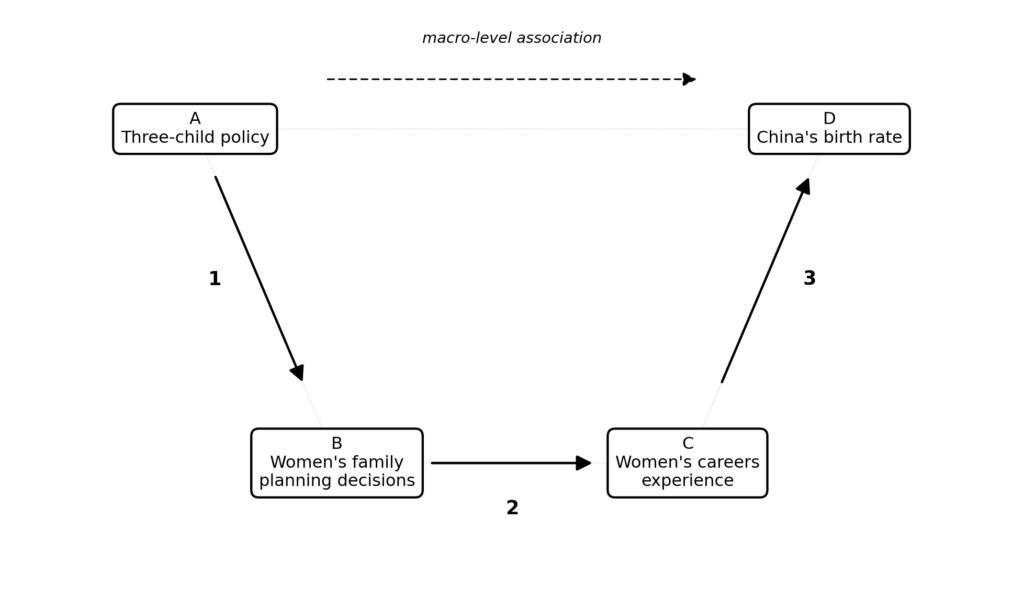
Figure 3. The applied bathtub model built on Coleman (1990, Foundations of Social Theory, Harvard University Press).
That shape is helpful, but in China, the organisation sits between the state and the individual. Figure 4 sketches how I extend the diagram into a multi-level bathtub model to describe China’s fertility politics: a national policy (node A) shapes women’s family-planning decisions (B); those decisions are bound up with women’s career experience (C); and the aggregated outcome returns as the country’s birth rate (D). A national call for more births can become an employer’s calculation of maternity risk (arrow 6, organisational policy). That calculation can become a woman’s decision to delay pregnancy. Many delayed decisions then return as low fertility statistics, which in turn prompt further policy revision (arrows 5 and 7).
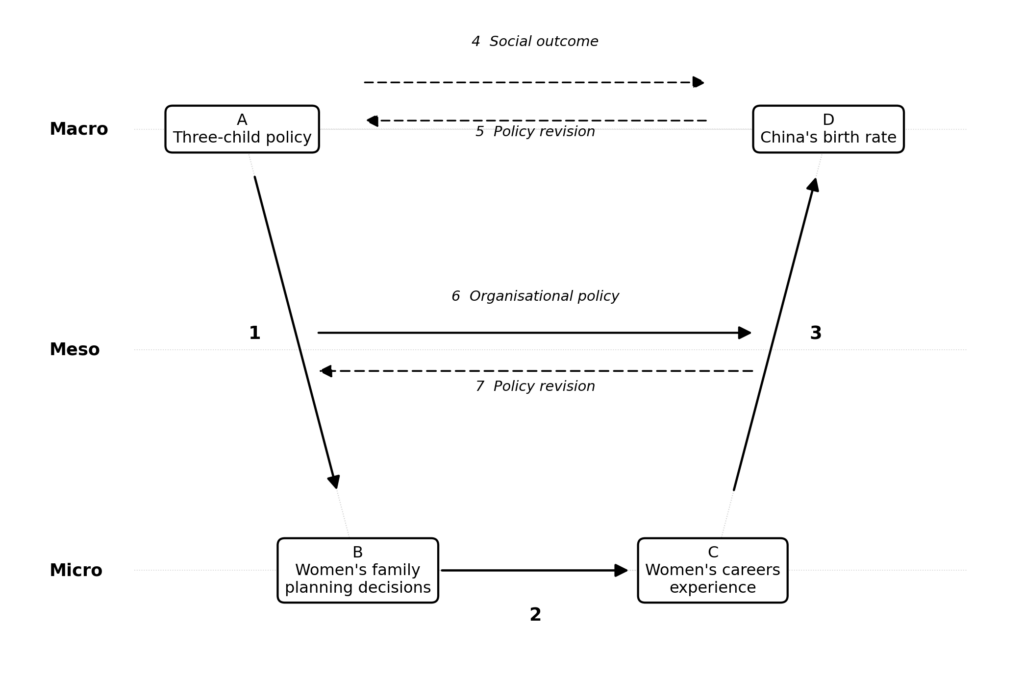
Figure 4. The elaborated multi-level bathtub model adapted from the author’s PhD thesis (Zhao, 2025, Figure 14).
Where the workplace meets the family
This argument sits alongside several useful ways of thinking about Chinese families. Yingchun Ji’s work on mosaic familialism describes contemporary family change not as a neat replacement of tradition by modernity, but as a hybrid process in which renewed family obligations live alongside individual choice. Jieyu Liu’s Embedded Generations makes a similar caution, reminding us that family lives are embedded in state projects, generational memory and unequal resources. Yue Qian and Yang Hu’s multilevel framework for the digitalization of family life likewise shows why family change must be traced across social levels, including digital environments. The workplace belongs more firmly in this picture: fertility decisions are formed where demographic governance, organisational risk and intimate responsibility meet.
Seen this way, the usual policy question becomes too narrow. It is not enough to ask why women do not want more children. A better question is why motherhood is still offered on such unequal terms. At the same time, what role has (the husband’s) masculinity played in contributing to China’s fertility problem? A woman may hear that childbirth is supported, while at the same time her employer treats maternity leave as disruption, her family assumes she will coordinate care, and online debate praises sacrifice while mocking women who refuse it. In that situation, reluctance is not a rejection of family life. It is a response to the conditions under which family life is being proposed.
Into the digital public sphere
These mechanisms do not stop at the office door; they run on into the digital public sphere. Chinese social media platforms such as Xiaohongshu (Rednote), Douban, Weibo, and short-video apps do more than host opinions after policy has been announced. They give women a place to compare risk, share workplace stories and test what can be said in public. Studies of social media exposure and support for the three-child policy and childbirth discussion on Chinese social media show that online debate shapes attitudes through trust, perceived cost and emotional recognition.
Digital space, however, is not simply liberating. It also carries backlash. Research on anti-feminism on Chinese social media and nationalised anti-feminism shows how gender criticism can be ridiculed, moralised or framed as foreign. A recent feminist critique of China’s shift from the one-child policy to the three-children initiative makes a related point: very different population policies can still share a concern with governing women’s bodies. Once motherhood is framed as patriotic duty, women who hesitate are asked to defend more than a private choice. They are asked to defend their relationship to the nation.
A debate about trust
China’s low fertility debate is therefore, at heart, a debate about trust. The trust in question is perhaps not only the private confidence between a woman, her employer and her family; it is probably also political. Survey work now links a woman’s trust in government directly to her intentions to have children, and the wider scholarship on political trust in China treats confidence in the state and its promises as a quiet precondition for whether citizens act on a policy or simply decline it. Seen this way, the three-child policy’s disappointing returns are not due to insufficient incentives, but because it leaves untouched the very conditions (e.g., care, careers, protection from discrimination) that would make the promise credible. More childcare would help. So would stronger anti-discrimination enforcement, credible career protection and a more equal division of care within families. Yet policy also has to change the story it tells about women. Women are not demographic infrastructure. They are workers, daughters, partners, citizens and persons with futures of their own. Until those terms change, the promise of reproductive freedom will remain conditional, and women will not simply ask whether they may have another child. They will ask what that “invitation” actually costs.